
In recent years, the Poste Italiane Group has embarked on a journey of profound technological and digital transformation, focusing on technological intensity, i.e. the ability to rapidly adopt exponential technologies, such as Artificial Intelligence (AI), into its infrastructure and organisations.
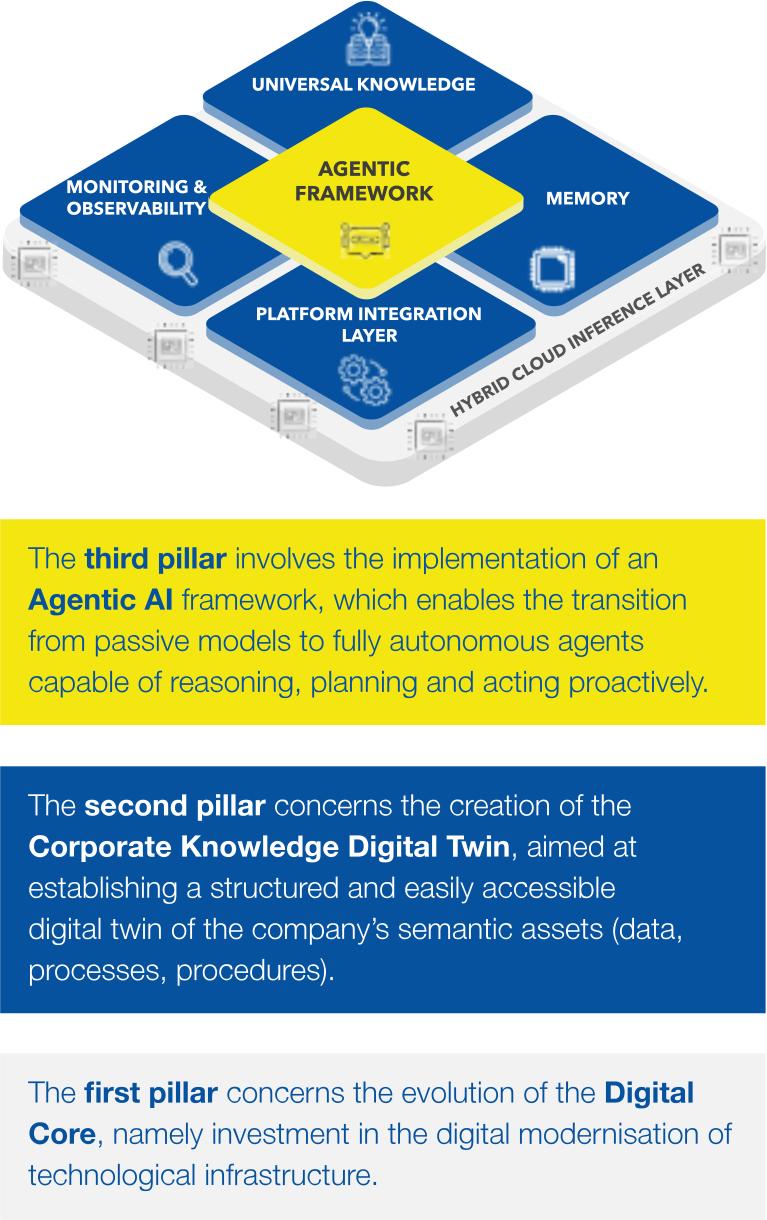
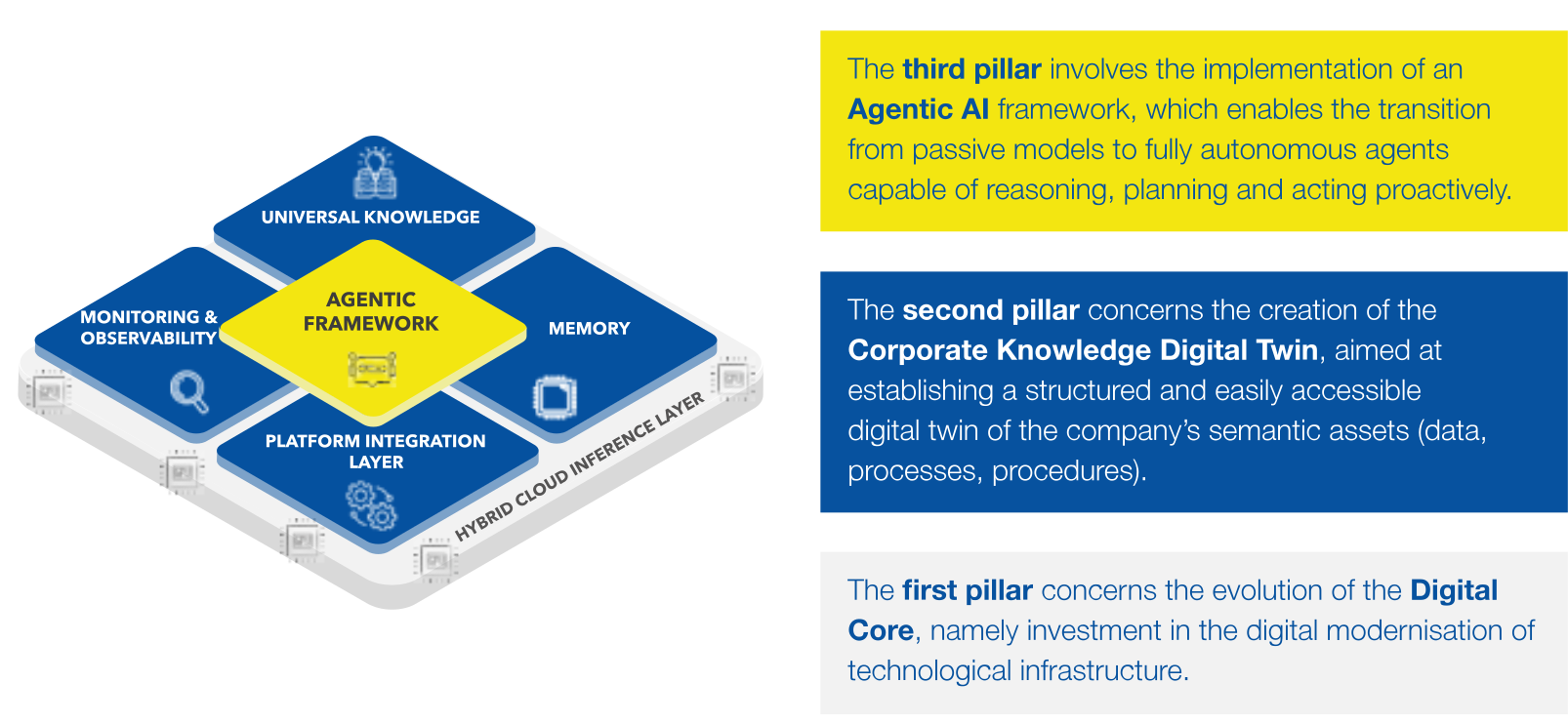
To make Artificial Intelligence fully scalable and sustainable, Poste Italiane has embarked on a path towards an advanced technological platform, based on three fundamental pillars.
3 pilastri
The technology platform enables Poste Italiane’s Enterprise Digital Brain, enabling a truly transformative use of Artificial Intelligence to redefine processes and services. It also ensures scalable adoption at the Enterprise level and is sustainable over time, while maintaining the confidentiality of critical information thanks to a hybrid infrastructure that combines cloud and on premise, and which can also leverage the infrastructure of the National Strategic Hub (PSN). With reference to the latter, please refer to what is illustrated in Chapter 3 Outlook.
With regard to use cases, Artificial Intelligence represents a fundamental accelerator of the pillars of the Poste Italiane Strategic Plan, namely:
- Business Service Model: thanks to the ability to analyse large volumes of data — more than 4 billion transactions analysed in the year 2025 — Artificial Intelligence enables a deeper understanding of customers that allows anticipating their needs. This information is shared in an integrated manner with both traditional physical channels and digital channels, with the aim of fostering an increase in cross selling, collection and improvement of the Group’s customer experience. Key use cases include the hyper personalisation of the Poste Italiane app and advanced customer profiling to support financial advisors. In particular, for the latter, a path has been set in motion to introduce new AI and data-enabled business tools that can support advisors in managing customers. In addition, in 2025, the possibility of booking a Post Office appointment by telephone was introduced using generative Artificial Intelligence, which makes the booking service accessible even to customers who are not inclined to use digital channels. For Post Office employees, services are being deployed that facilitate the consultation of internal procedures and documentation, through an intelligent search functionality enabled by generative AI that allows natural language interaction.
- Logistics: Data and AI are one of the key enablers for the transformation of the Poste Italiane logistics network, which handles more than 1 million parcels every day. In particular, the adoption of predictive models makes it possible to optimise the entire supply chain, from planning through warehouse management to deliveries. This approach has significantly reduced operating costs, emissions and delivery times. By way of example, the models concern the prediction of daily parcel volumes, optimisation of middle-mile1 routes and optimisation of vehicle saturation.
With reference to the transversal contribution to the execution of the Strategic Plan, Artificial Intelligence has strengthened and made the Poste Italiane operational machine more efficient, intervening in three key areas:
- Customer Service: a new hybrid “human/AI” service model is being introduced that offers customised experiences according to the level of digitalisation of customers and enables a significant reduction in cost to serve. Prominent among the main use cases is the AI Know Platform, a solution that makes content easily accessible to contact centre operators for easy reference, making it easier for staff assisting customers to fulfil their requests in all areas of business.
- IT: AI started to further optimise the IT model applied across the board for both the development of new products and their requisitioning and the automation of development activities and operations.
- Corporate Employees: some solutions aimed at facilitating the work of Corporate employees are being explored, such as, for example, the integration of Microsoft Co Pilot into corporate devices, the adoption of a Chat with Your Data assistant to explore, analyse and interrogate corporate data, and the development of a dedicated assistant for training content.
In the constant confirmation that ethics is the key to move from innovation to sustainable development, starting from the drafting of the Ethical Manifesto in the field of Artificial Intelligence, finalised in December 2024, the activities continue of setting up Governance for the fulfilments indicated in the European Regulation (EU) 2024/1689, known as the AI Act, in compliance with the dates indicated therein2. The Manifesto has three essential components: ethicality, robustness and legality. In accordance with these principles, AI must ensure adherence to ethical values such as transparency, inclusiveness and sustainability. Poste Italiane is also committed to developing secure and reliable solutions to protect users from the risks of artificial intelligence, fuelling confidence in digital growth. Finally, AI must be fair, comply with all applicable laws and regulations, to protect people’s dignity, leaving no-one behind.
In addition to the completion of the survey of systems for the assessment of prohibited applications3 under the AI Act, updated on 31 July 2025, in order to exclude cases falling under Art. 5 of the aforementioned regulation, an Artificial Intelligence Committee was set up during the first half of 2025 with the aim of assessing, approving and monitoring the use of AI within the Poste Italiane Group, ensuring that applications are aligned with the Company’s strategic objectives and comply with ethical, legislative and regulatory standards.
This Committee has met twice since its establishment, examining the main corporate initiatives using this technology from the perspective of strategic opportunity, risk and impact on the internal population. There, the use cases inventoried in 2025, analysed by the specialist functions according to the internal governance models, were also illustrated, with the aim of concluding the analyses of the entire inventory within the AI Act deadlines.
In parallel, outreach activities continued to promote an internal culture for the adoption of secure, transparent and traceable AI technology to protect citizens’ fundamental rights and European values. In this regard, the Artificial Intelligence Ethics Manifesto was the subject of a dedicated in-depth session with all company management, and was published on the institutional website, for the transfer of this culture to all personnel.
1. The Middle Mile Logistics identifies the intermediate transport phase that connects the main nodes of the logistics network — hubs, sorting centres, logistics centres — placing it between the first mile, pick-up/entry into the network, and the last mile, final delivery. This phase encompasses the volume handling flows between the nodes of the network, using dedicated means of transport, and is characterised by planning, routing and monitoring processes aimed at ensuring efficient loading of means, punctuality of transport and compliance with delivery SLAs. Within the framework of Poste Italiane systems and initiatives, the middle mile constitutes a distinct and measurable perimeter of the supply chain, the subject of operational control activities, flow analysis, optimisation of vehicle saturation and assessment of network performance, also through analytics solutions and logistics simulation.
2. The main deadlines in the AI Act are: 2 August 2026 for the start of implementation of the AI Act Regulation for high-risk systems and 2 August 2025 for the governance and supervision of general purpose AI (GPAI) models, i.e. models not designed for specific purposes, such as Chat GPT.
3. Prohibited practices are set out in Art. 5 of European Regulation (EU) 2024/1689, AI Act. Examples include: subliminal behavioural manipulation, such as AI systems designed to unconsciously or subliminally influence human behaviour; exploitation of vulnerabilities, such as the use of AI to exploit people’s vulnerabilities due to age, disability or social conditions, impairing their ability to choose; social scoring by public authorities, such as systems that assess or classify people on the basis of their behaviour or personal characteristics, with discriminatory effects; real-time biometric recognition in public places to carry out risk assessments of individuals to assess or predict the risk of a natural person committing a crime, based on profiling a natural person or assessing personality traits and characteristics; AI that mimics or pretends to be human in a misleading way, such as applications where it is not clearly indicated that it is an artificial system.