
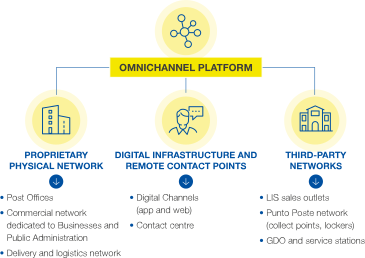
The Group’s omnichannel platform provides for the monitoring of customers and the provision of services through 3 main types of channels:
- the proprietary physical network: this consists of the Post Offices, the sales force for business customers and the logistics network for mail and parcel delivery;
- a digital infrastructure and remote contact points: made up of all the Group’s digital channels (app e web) and the contact centre, capable of serving the entire national population;
- the third-party network: made up of more than 49 thousand1 points, the result of commercial partnership agreements for the marketing of Group products and services managed also through the acquisition of the company LIS.
Title:
Poste Italiane’s omnichannel platform
Description:
Poste Italiane’s omnichannel platform is divided into three interconnected networks:
Proprietary physical network
- Post Offices
- Commercial network dedicated to Businesses and Public Administration
- Delivery and logistics network
Digital infrastructure and remote contact points
- Digital Channels (app and web)
- Contact centre
Third-party networks
- LIS sales outlets
- Punto Poste network (collect points, lockers)
- GDO and service stations
Physical network of Post Offices
31 December 2025 | 31 December 2024 | |||
|---|---|---|---|---|
Unit | Personnel | Unit | Personnel | |
| Macro Areas Post Office Network | 6 | 536 | 6 | 492 |
| Branch offices | 132 | 4,543 | 132 | 4,282 |
| Post Offices | 12,659 | 46,116 | 12,755 | 47,254 |
| Total |
| 51,195 |
| 52,028 |
All workforce data is shown in full-time equivalent terms in thousands.
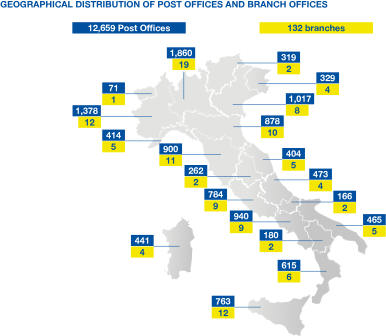
Title: Distribution of Post Offices and Branches
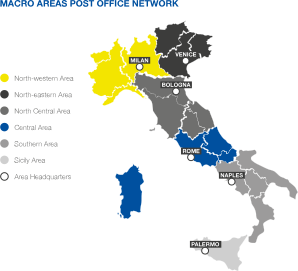
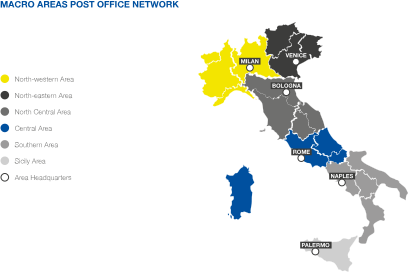
The map shows the macro areas of Poste Italiane’s Post Office Network in Italy, with the related Area Headquarters.
Legend of geographical areas:
- North-western Area
Includes the regions of Piedmont, Aosta Valley, Liguria and Lombardy.
Area Headquarters: Milan - North-eastern Area
Includes the regions of Veneto, Trentino-Alto Adige and Friuli-Venezia Giulia.
Area Headquarters: Venice - North Central Area
Includes the regions of Emilia-Romagna, Tuscany, Marche and Umbria.
Area Headquarters: Bologna - Central Area
Includes the regions of Lazio, Abruzzo, Molise and Sardinia.
Area Headquarters: Rome - Southern Area
Includes the regions of Campania, Apulia, Basilicata and Calabria.
Area Headquarters: Naples - Sicily Area
Includes the region of Sicily.
Area Headquarters: Palermo
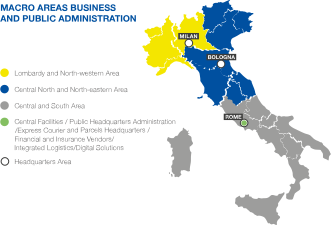
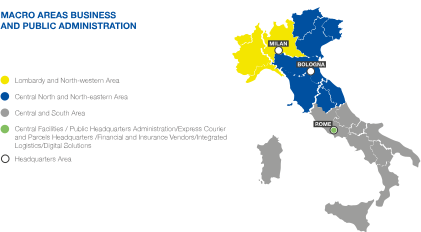
Physical network - Business and Public Administration
The commercial supervision and sale of the Group’s products and services to businesses and Central and Local Public Administration is guaranteed by Poste Italiane’s Business and Public Administration function.
The organisation of the sales force guarantees territorial coverage focused by product sector, through:
- 3 Sales Macro Areas (Lombardy North West, Central North and North East, Central and South), with exclusive commercial responsibility for mail and communication revenue;
- 1 Commercial area for Central and Local Public Administration related to Metropolitan Regions and Cities;
- 1 Commercial area specialising in the offer of financial and insurance products for large business customers and Public Administration;
- 1 Sales Area dedicated to the offer of Express Courier and Parcels (CEP) products/services;
- 2 business areas specialising in Integrated Logistics and Digital Solutions respectively.
The logistics network
The Group’s mail and parcel services are provided through two integrated and synergistic logistics networks: the postal logistics network for the management of mail, now evolved to help manage small parcels and the parcel logistics network. The delivery of these small parcels in Italy can be carried out synergistically by the postal logistics network and the courier logistics network according to a dynamic approach, aimed at maximising efficiency for each individual area.
As part of the transformation plan for the Mail and Parcels segment and with the aim of making the Poste Italiane Group an integrated logistics operator, an important initiative was launched in 2023 to develop the Integrated Logistics market segment2. To strengthen the Group’s presence in this business, Poste Logistics SpA was created in March 2024.
In addition, from the second quarter of 2022, the Poste Italiane Group entered the healthcare logistics market through the acquisition of the company Plurima, which has been operating in the hospital sector for several years, offering logistics solutions and services such as outsourced pharmaceutical warehouse management.
As of February 2024, the Poste Italiane Group is also active in fresh food logistics, through the refrigerated transport service (PosteGoFresh3) offered through MLK Fresh.
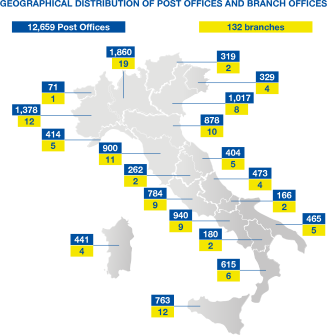
Title: Distribution of Post Offices and Branches
Total:
- 12,659 Post Offices
- 132 branches
The distribution by region is as follows:
- Piedmont
1,378 Post Offices
12 branches - Aosta Valley
71 Post Offices
1 branch - Lombardy
1,860 Post Offices
19 branches - Trentino-Alto Adige
319 Post Offices
2 branches - Veneto
1,017 Post Offices
8 branches - Friuli-Venezia Giulia
329 Post Offices
4 branches - Liguria
414 Post Offices
5 branches - Emilia-Romagna
878 Post Offices
10 branches - Tuscany
900 Post Offices
11 branches - Umbria
262 Post Offices
2 branches - Marche
404 Post Offices
5 branches - Lazio
784 Post Offices
9 branches - Abruzzo
473 Post Offices
4 branches - Molise
166 Post Offices
2 branches - Campania
940 Post Offices
9 branches - Apulia
465 Post Offices
5 branches - Basilicata
180 Post Offices
2 branches - Calabria
615 Post Offices
6 branches - Sicily
763 Post Offices
12 branches - Sardinia
441 Post Offices
4 branches
Digital infrastructure and remote contact points - web, app and contact centre
The Poste Italiane Group has implemented a programme of “digital transformation” aimed at innovating service and offer models in order to guarantee its customers contact experiences integrated in an omnichannel approach.
In 2025, the Group continued to work on improving the digital channel experience (app and web) intervening both on simplification of interactions and operations and on strengthening the digital sales channel, with particular attention to the development of the single Poste Italiane app.
The Group’s digital channels (app and web) are as follows:
- Poste Italiane app: a profound process of transformation and enrichment, launched in 2023, has led it to become the app with which customers can manage, through a single point of access, all of the Company’s products and services such as financial, payment, savings, telecommunications, utilities and insurance products; in addition, the new single app also allows simplified access to the physical network thanks to the possibility of booking appointments at the Post Office, sending and managing mail and parcels, and pre-filling forms to speed up operations at the Post Office. In 2025, the app was progressively completed with the introduction of the last remaining functionalities and enriched with new services; in addition, communication campaigns (via e-mail, information pages and in-app push) have been completed to encourage customers to migrate from BancoPosta and Postepay apps. In the first part of the year, activities were started for the phasing-out of the BancoPosta app, completed in July 2025, and, starting in October 2025, activities were started for the phasing-out of the Postepay app, completed in November 2025.
- Poste.it website: this is the Group’s consumer and business portal, where it is possible to browse the range of services offered and which allows customers to consult and manage the products they own. In March 2025, the site was aligned with the experience defined for the app with the aim of ensuring continuity of customer experience and consistency in the use of omnichannel functionality. Therefore, both the public area and the reserved area dedicated to customers were renewed, with a focus on the cross-sections (notice board, profile, highlighted area) and the areas dedicated to products (Postepay accounts and cards in March 2025 and postal savings in June 2025); the process is continuing with the evolution of the other products (insurance, energy).
In addition, Poste Italiane also manages:
- Poste Business app: app for managing the main financial services (accounts, cards, collections) dedicated to Professionals and Small/Medium Enterprises;
- PosteID app: the Poste Italiane Digital Identity app (SPID - Sistema Pubblico d’Identità Digitale).
Third-party physical network
In the Group’s omnichannel strategy, a crucial role is played by third-party networks, which complement the network of Post Offices for accessing transactional services. This is a network for the offer/delivery of Group products/services through third-party distribution channels.
Poste Italiane has contracted a large network of commercial activities, reaching an articulation of approximately 49 thousand points at 31 December 2025.
The acquisition of LIS, which took place in September 2022, made it possible to increase the operations of the omnichannel platform, increasing the volume of business on third-party networks with the transactions carried out on LIS points relating to products also not belonging to the Poste Italiane Group’s offer. Average daily transactions increased in 2025 to over 1 million4 (+8% y/y), of which LIS points represent approximately 90%, both with Poste Italiane Group’s products and others.
In particular, the Group’s strategy for third-party networks aims to achieve the following objectives:
- develop and harmonise the commercial offer on third-party networks in order to make additional physical touchpoints available to customers and, at the same time, enhance cross-selling opportunities;
- generate commercial synergies with the post office network;
- guarantee capillarity and quality in parcel collection and forwarding services thanks to the Punto Poste network. At 31 December 2025, the network is represented by about 18,300 collect points, of which about 16,000 are LIS points (tobacconists). Thanks to the partnership with Deutsche Post DHL Group, the expansion of the Punto Poste network is underway with the locker asset (about 1,300 active lockers at 31 December 2025) positioned mainly in metropolitan areas and areas with high e-commerce traffic. In total, the Punto Poste network (collect points and lockers) had about 19,600 points at the end of 2025, and the volumes handled5 by the Punto Poste network in 2025, amounted to about 67 million collections and consignments, an increase of 93% compared to the year 2024.
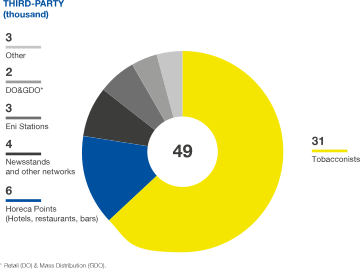
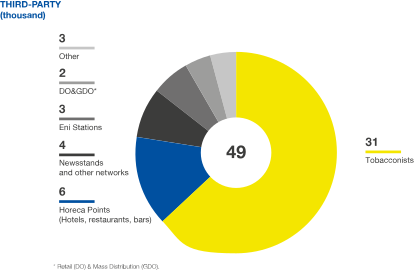
Title: Third-Party Networks
The chart shows the composition of Poste Italiane’s third-party network, expressed in thousands.
Total: 49 thousand
The third-party network is divided as follows:
- 31 thousand Tobacconists
- 6 thousand Horeca Points (Hotels, restaurants, bars)
- 4 thousand Newsstands and other networks
- 3 thousand Eni Stations
- 2 thousand DO&GDO*
- 3 thousand Other
Note:
- Retail (DO) & Mass Distribution (GDO).
PUDO (Pick Up - Drop Off) network
The structural growth of e-commerce has transformed delivery models and consumer expectations: among these, Out of Home Delivery (OOHD) is emerging as an increasingly popular solution.
Flexibility and accessibility are the main determinants behind consumers’ choice of OOHD: the ability to pick up or deliver shipments at locations and times compatible with their lifestyles effectively responds to new consumer habits, while reducing the critical issues associated with traditional home delivery. At the same time, OOHD helps reduce the environmental impact by, for example, minimising vehicle mileage and reducing CO2 emissions by delivering more items per delivery point. In recent years, the Poste Italiane Group has continued to invest in strengthening its PUDO (Pick-Up-Drop-Off) network, making it increasingly capillary and integrated across the territory.
In addition to the network of Post Offices used for the post hold service, the Group’s OOHD network also consists of the Punto Poste network, consisting of collect points (shops) and automated lockers at which the customer/seller can have their shipments delivered. At 31 December 2025, the Group’s OOHD network had approximately 31,350 thousand physical points, supporting customers and e-commerce operators.
1. Figures at 31 December 2025.
2. It represents the integration of warehousing services (goods entry, warehousing, order management/arrangement, shipment preparation) and distribution services. B2B distribution is carried out through Poste Delivery Business express courier services or through FTL (Full Track Load) or LTL (Less Than Truck Load) services. B2C distribution is carried out through Poste Delivery Business express courier services.
3. The refrigerated transport service for home delivery of fresh food products purchased on-line.
4. Average daily production conventionally calculated on the basis of 7 days.
5. The figure includes the processing handled at the individual points of the Punto Poste network (processing could also be double - both acceptance and collection at two different points of the network - concerning the same parcel).